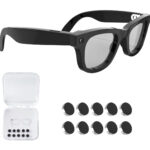


Smart Glasses vs Smart Watch: Which Wearable Wins in 2026?

You already carry a smartphone everywhere. So when you’re considering spending another $100, $200, or $300 on a wearable, the question isn’t just which one to pick — it’s which one actually changes how you live. Smart watches have had a decade-long head start. But in 2026, AI-powered smart glasses are a legitimate alternative, and the price gap makes this a genuinely interesting decision.
These two categories aren’t really competing on the same features. But they are competing for the same spot in your budget. Here’s what each one actually delivers.
What Smart Watches Do Really Well
Smart watches are genuinely excellent at health monitoring. If you want continuous heart rate data, sleep tracking, blood oxygen levels, or fall detection, nothing on the market competes. The Apple Watch can detect irregular heart rhythms, share crash data with emergency services, and give you a surprisingly complete picture of your body over time.
They also extend your phone in ways that feel useful — notifications, quick replies, Apple Pay at checkout. For runners, cyclists, and anyone managing a chronic health condition, that ecosystem has real value.
If you’re buying a smart watch, buy it for the health data. That’s where the genuine advantage lives.
What AI Smart Glasses Do That a Watch Can’t
A smart watch puts a second screen on your wrist. Smart glasses remove the screen entirely.
With AI glasses, you’re talking to an assistant hands-free — no tapping, no squinting at a tiny display. Open-ear speakers deliver responses without earbuds. You can capture 12MP photos and 1080p video without pulling your phone out. You hear navigation cues, voice messages, and music without blocking out the world around you.
Think about the moments where that actually matters — driving, cooking, hiking, a meeting where you need to look something up without being visibly distracted. A watch makes those moments slightly easier. Glasses eliminate the friction entirely.
The use case is fundamentally different: it’s not about monitoring yourself. It’s about interacting with the world while keeping your hands free.
The Real Cost of Each
The Apple Watch SE starts at $249. The Series 10 starts at $399. Ray-Ban Meta — the most recognized name in AI glasses right now — is $299, with price increases already announced.
Aventa Smart Glasses are $109. That’s not a sale price. It’s regular retail, with free shipping from a US warehouse, 2–5 business day delivery, and a 30-day money-back guarantee.
At $109, the conversation shifts. You’re not choosing between a luxury purchase and a budget compromise. You’re asking whether the AI glasses category is worth exploring at the price of a nice dinner out.
Side-by-Side Comparison
| Feature | Aventa Smart Glasses | Ray-Ban Meta | Apple Watch SE |
|---|---|---|---|
| Price | $109 | $299 | $249+ |
| AI Assistant | Yes — ChatGPT-compatible | Meta AI | Siri only |
| Camera | 12MP / 1080p video | 12MP / 1080p video | None |
| Open-Ear Audio | Yes | Yes | No |
| Health Tracking | None | None | Full suite |
| Battery | ~3hr + charging case (full day) | ~4hr | ~18hr |
| Prescription Lenses | Yes (custom order, ships in +7 days) | No | N/A |
| Subscription Required | None | Meta+ for some features | None |
| Weight | 48g | 49g | Wrist-worn |
| Connectivity | Bluetooth 5.0 | Bluetooth 5.3 | Bluetooth 5.3 + LTE option |
Who Should Buy a Smart Watch
- Health is your priority: Continuous heart rate, ECG, blood oxygen, sleep stages — the Apple Watch ecosystem is the most mature in the world for this.
- You’re training for a race: GPS tracking, VO2 max estimates, workout detection — the Apple Watch handles serious athletes well.
- You have a specific health concern: AFib detection, fall detection, and emergency SOS are legitimately life-useful features.
- You want a deep app ecosystem: Years of third-party development means there’s a Watch app for almost everything.
Who Should Buy AI Smart Glasses
- You’re tired of missing moments: Phone out, fumble, blur — AI glasses let you capture in real time without breaking what you’re doing.
- You want a hands-free AI assistant: Voice-activated, ChatGPT-compatible, actually usable while your hands are occupied.
- You wear prescription lenses: Aventa can be ordered with your prescription built in — something Ray-Ban Meta doesn’t offer at all.
- You already have a fitness tracker: If a Fitbit or older Apple Watch already handles your health data, glasses fill a completely different gap.
- You want something that feels new: Smart watches have existed since 2015. Most people have never worn a pair of AI glasses. That’s not a trivial thing.
The Honest Verdict
If health tracking is your priority, a smart watch earns its price. The Apple Watch is excellent at what it does, and nothing else does it as well. That’s a fair call.
But if you’re looking for the more interesting wearable experience — one that changes how you interact with the world rather than just how you monitor yourself in it — smart glasses make a compelling case. Hands-free AI, open-ear audio, camera capture without phone fumbling, no forced subscriptions, and at 48g, slightly lighter than the Ray-Ban Meta.
At $109 versus $299 for the closest glasses competitor, Aventa isn’t asking you to take a leap of faith on an expensive experiment. The 30-day return window means the risk is low. And if it clicks with your daily routine, you’ll wonder why you waited.
For most people weighing smart glasses vs smart watch as their next wearable purchase, glasses are the more interesting bet in 2026 — and the value case has never been stronger. See the full specs at aventaglasses.com.
Last updated: May 2026