

Smart Glasses for Warehouse Workers: Hands-Free on the Job

Every minute you spend pulling out your phone to log a scan, snap a photo, or look up a procedure is a minute your hands aren’t on the work. Multiply that across a full shift and a full team, and “just check your phone real quick” starts adding up to something you’d rather not calculate.
Smart glasses have been the obvious fix for years. The problem was always the price: enterprise AR headsets start at $1,000 per unit, built for Fortune 500 IT budgets, not lean operations or small pilots. That math has changed.
What Hands-Free Smart Glasses Actually Do on the Floor
Forget the sci-fi overlays. Current smart glasses for industrial use are more practical than cinematic. The core value is simple: you keep both hands on the work while information flows to and from you through voice and a camera.
- Voice assistant access — ask a question, get an answer through the earpiece without stopping what you’re doing
- Hands-free recording — trigger a video or photo by voice to document a defect, capture a process step, or record a procedure walkthrough
- Photo documentation — 12MP photos of inventory, damage, or equipment status, no device in hand
- Open-ear audio — speakers that don’t block ambient sound, so you stay aware of the floor environment
- AI integration — ChatGPT-compatible voice assistant means real answers to real questions: torque specs, error codes, SKU lookups
None of this requires gloves off, device out, app open, device away. That’s the actual workflow change.
Why Enterprise AR Doesn’t Reach Most Operations
Companies like Vuzix, RealWear, and Google (Glass Enterprise Edition) make genuinely capable industrial smart glasses. Heads-up displays, native barcode scanning, ERP integrations — the full stack is there.
So is the price. A single unit runs $1,000 to $5,000+, plus software licensing, IT deployment, and ongoing support contracts. Equipping a 20-person receiving team becomes a six-figure conversation before you’ve proven a single hour of ROI.
Most mid-size operations skip the pilot entirely and keep doing things the slow way. Not because smart glasses aren’t useful — because the entry cost makes the risk feel too high.
What the Aventa Smart Glasses Actually Include
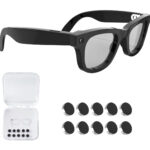
The Aventa Smart Glasses are priced at $109. That’s not a stripped-down version with the useful parts removed. Here’s the full spec sheet:
- Camera: 1080p video recording, 12MP photos — enough for documentation, defect capture, and procedure walkthroughs
- AI voice assistant: Built-in, ChatGPT-compatible — hands-free queries, hands-free answers
- Audio: Open-ear speakers and microphone — ambient awareness preserved, communication clear
- Battery: ~3 hours active use; included charging case extends that to a full workday
- Connectivity: Bluetooth 5.0, pairs to your phone for data, calls, and assistant access
- Weight: 48g — lighter than Ray-Ban Meta at 49g, comfortable for all-day wear
- Prescription lenses: Custom orders available, ships within 7 business days
- No subscription required — Ray-Ban Meta locks some features behind Meta+; Aventa does not
Ships from a US warehouse in 2–5 business days. 30-day money-back guarantee.
Where Hands-Free Glasses Actually Earn Their Place
Receiving and inbound inspection — photograph each pallet as it comes off the truck, note discrepancies by voice, keep both hands on the freight. The clipboard-and-phone juggle disappears.
Quality control walkthroughs — trigger a timestamped video on a defect by voice, move to the next station. Documentation that used to require stopping, unlocking, photographing, and re-pocketing happens in under five seconds.
Procedure training — a veteran worker records a first-person walkthrough of a complex task. That’s a training asset that didn’t require a camera crew or a studio.
Remote assist — pair with a phone, share a live camera feed with an offsite supervisor or technician. They see exactly what you see while you describe the problem. That replaces a lot of on-site service calls.
On-line AI lookups — “What does error code E44 mean on this conveyor?” Voice query, voice answer, hands stay on the machine. For workers who regularly troubleshoot or cross-reference specs, this alone justifies the purchase.
Aventa vs. Enterprise Smart Glasses: Side by Side
| Feature | Aventa Smart Glasses | Enterprise AR (Vuzix, RealWear) |
|---|---|---|
| Price per unit | $109 | $1,000–$5,000+ |
| Camera | 1080p video, 12MP photos | Varies; some comparable |
| Heads-up display | No | Yes — overlay display |
| AI voice assistant | Yes, ChatGPT-compatible | Limited or paid add-on |
| Battery life | 3 hrs + full-day case | Varies; some all-day |
| ERP / WMS integration | Via phone and third-party apps | Native integrations available |
| Prescription lens support | Yes, custom order | Rare; often expensive add-on |
| Subscription required | No | Often yes |
| Pilot risk | Low — $109 per unit | High — five-figure commitment |
Enterprise AR wins on heads-up overlay and native software integrations. If your operation specifically needs either of those, the enterprise options exist for a reason. For everything else, the gap between $109 and $1,000+ is hard to defend.
Who These Are Actually For
- Small-to-mid-size warehouses running lean teams where enterprise AR pricing simply doesn’t fit the budget
- Operations managers running a hands-free pilot before committing to a full enterprise platform
- Field technicians and inspectors who need photo and video documentation without carrying a tablet
- Training leads who want first-person POV footage of procedures without hiring a videographer
- Workers who wear prescription glasses — the custom lens option makes these usable for a significant portion of the workforce, which enterprise units rarely address affordably
- Supervisors equipping multiple workers — at $109, a 10-person team costs less than a single enterprise AR unit
They’re not the right call if you need native barcode scanning integrated with your WMS, a heads-up display overlay, or IP67 hardening for heavy industrial environments. For those requirements, the $1,000+ options are what they are.
The Honest Verdict
Enterprise smart glasses are real products solving real problems. For large operations with IT infrastructure and integration requirements, the price can be justified.
For the majority of warehouses and factory floors that need hands-free recording, voice AI access, and photo documentation — and don’t have a five-figure pilot budget — the Aventa’s $109 price point changes the calculation entirely.
At that price with a 30-day money-back guarantee, the downside risk is essentially zero. You can put five pairs on a team for less than the cost of one enterprise unit’s software license and find out whether hands-free actually changes your workflow before committing to anything larger.
If it doesn’t work for your operation, send them back. If it does, you have a solution that paid for itself the first week.
See the Aventa Smart Glasses at aventaglasses.com — in stock, ships from the US in 2–5 business days.
Last updated: May 2026