

Motorcycle Smart Glasses: Hands-Free Navigation and Ride Recording

You’re 40 miles into a mountain pass, wind in your face, scanning the next bend. Your phone buzzes in the tank bag — probably a turn coming up. You either miss it and add 20 minutes to your route, or you glance down and take your eyes off a curve at 55mph. Neither is a good option.
That’s the problem smart glasses for motorcycle riding actually solve. Not in a gimmicky way — in a “you stop looking down entirely” way. Here’s what you need to know before you buy.
Why Tank Bag Phone Mounts Fall Short on Two Wheels
Phone mounts work fine in a car. On a bike, they fall apart fast.
Even at 45mph, checking a screen requires you to look away from the road, refocus your eyes, process the information, and reacquire the road ahead — all while managing throttle and lane position. In rain or direct sun, glare makes the display near-unreadable. In stop-and-go city traffic, every glance adds up to real distraction.
And audio from a phone speaker? The wind drowns it out before it reaches you. You either miss the turn cue or you’re riding with earbuds in, which is uncomfortable under a helmet and restricted or banned for motorcycle use in many states.
How Smart Glasses Handle Navigation on a Motorcycle
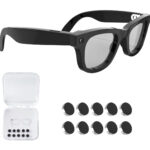
The Aventa G100 has open-ear speakers built into the arms of the frame. They sit just above and in front of your ears — tucked inside most full-face helmet cheek pads, or resting naturally against your head in open-face and half helmets.
Pair them to your phone via Bluetooth 5.0 and run Google Maps or Waze exactly like you normally would. Spoken turn directions come through the speakers directly to your ears, loud enough to cut through road and wind noise in most helmets at highway speeds. Your phone stays in your pocket or tank bag. Your eyes stay on the road.
The built-in voice assistant — compatible with ChatGPT — also handles quick commands while riding. Send a message, check estimated arrival, skip a track — all without touching anything. Just talk at a stoplight or when you slow down.
Capturing Your Ride: What the Camera Actually Does
The G100 records 1080p video and captures 12MP photos from a camera built into the bridge of the frame. That lens sits roughly at eye level, which turns out to be a better angle for motorcycle footage than most people expect.
For dashcam-style documentation of incidents or close calls, this perspective shows exactly what you saw at the moment it happened — more useful than a chest or chin mount. For road trip footage, it captures the ride without requiring you to stop and set up a separate action camera.
Battery lasts about 3 hours of active use. The charging case extends that to a full day, which covers most rides without you needing to think about it.
Helmet Compatibility: What Actually Works
This is the first question every rider asks. The honest answer depends on your lid.
- Open-face and 3/4 helmets: Straightforward fit. The glasses rest on your ears exactly like regular eyewear — no adjustment needed.
- Half helmets: Easiest of all. No compatibility issues worth mentioning.
- Full-face and modular helmets: Works with most adventure-touring and sport-touring styles that have reasonable space near the temples. The G100 weighs 48g — a gram lighter than Ray-Ban Meta — so pressure buildup on longer rides is minimal. If your cheek pads are particularly tight, test the fit on a short ride before committing to a full tour.
If you ride with prescription lenses, Aventa offers custom Rx orders — build in about 7 extra business days for those to arrive.
The Wind Noise Reality Check
The microphone picks up wind noise at speed. That’s just physics. If you plan to take phone calls while doing 70mph, you’ll sound like you’re reporting from a wind tunnel.
For receiving navigation cues and issuing voice commands, this doesn’t matter at all — the speakers push audio toward you, not the other way around. For quick voice assistant queries at a stop or below 40mph, the mic works cleanly.
If in-motion call quality is important to you, pair the G100 with a Bluetooth helmet communicator for voice calls and use the glasses for navigation and video. They do different things well; they’re not competing with each other.
Aventa G100 vs. Ray-Ban Meta vs. Phone on a Tank Bag
| Feature | Aventa G100 | Ray-Ban Meta | Tank Bag Phone Mount |
|---|---|---|---|
| Price | $109 | $299 | $20–$109 (mount only) |
| Navigation Audio | Open-ear speakers, hands-free | Open-ear speakers, hands-free | Phone speaker (wind-drowned) or earbuds |
| Ride Recording | 1080p built-in | 1080p built-in | None |
| Eyes Off Road to Navigate | No | No | Yes — look down to read screen |
| Subscription Required | No | Meta+ for some features | No |
| Frame Weight | 48g | 49g | N/A |
| Prescription Lens Option | Yes (+7 business days) | Yes (limited styles) | N/A |
| US Warehouse Shipping | 2–5 business days | Varies | Varies |
Who Should Buy Smart Glasses for Riding
- Touring riders doing long-distance routes who want navigation handled without ever looking at a phone
- Daily commuters in city traffic who want calls and directions managed without taking a hand off the bars
- Adventure riders who want ride documentation without the mounting hardware and battery juggling of a standalone action camera
- Riders considering Ray-Ban Meta who want to try smart glasses on the road before committing to $299
If high-quality phone calls while moving are your main use case, or if your helmet is so snug that glasses cause pressure points after an hour, this setup isn’t the right fit. Those are real limitations worth knowing before you order.
The Honest Verdict
Ray-Ban Meta is a genuinely good product. If you’re deep in the Meta ecosystem and $299 doesn’t sting, it’s worth considering — the brand has real engineering behind it and ongoing software support.
But for most riders, $109 buys everything that actually matters on a bike: hands-free navigation audio that cuts through helmet noise, continuous 1080p ride recording, and Bluetooth connectivity — without a subscription requirement and with a 30-day money-back guarantee if it doesn’t work with your helmet.
US warehouse shipping means it arrives in 2–5 business days. You could be riding with it this weekend.
If you want to try smart glasses riding without dropping $300 to find out if it’s for you, the Aventa G100 is the right place to start — see full specs at aventaglasses.com.
Last updated: May 2026