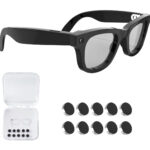


Aventa vs Ray-Ban Meta: Honest Camera Glasses Comparison

If you’ve spent more than five minutes researching camera glasses, you’ve come across two names: Ray-Ban Meta and the Aventa G100. They’re the most visible options in a category that suddenly feels like it’s everywhere — recording POV footage, taking calls hands-free, replacing the phone for quick captures.
The question we get asked the most is the obvious one: which is actually better? The honest answer is that they’re built for different buyers, and the right pick comes down to four things — privacy, price, prescription, and what you plan to do with them. Here’s the side-by-side.
The Specs, Side by Side
The headline numbers are closer than most people expect.
- Photo: Both shoot 12MP stills.
- Video: Both record 1080p.
- Audio: Both use open-ear speakers and built-in microphones — your ears stay clear, audio comes from above the ear.
- Controls: Both use a touch-sensitive temple for tap-to-capture and gesture control.
- AI: Ray-Ban Meta uses Meta AI. Aventa uses a ChatGPT-style assistant.
- Battery: Both land in the 3–5 hour active-use range, with charging cases that extend total runtime.
On paper, the hardware is genuinely comparable. The differences show up in the details — and in what each company does with the data.
Where Aventa Wins
Price
Ray-Ban Meta starts at $299 for the base frame, and prescription lenses are routed through their lens partner — typically pushing the all-in cost north of $500. The Aventa G100 sits around $189, with prescription lenses built into the standard buying flow rather than tacked on as a separate vendor visit. For most buyers, the all-in difference is several hundred dollars for a camera spec that’s effectively the same.
Privacy
This is the part most buyers don’t think about until after they’ve owned the glasses for a week.
Ray-Ban Meta requires a Meta account. Footage and metadata flow back to Meta. Frame use is tied to your Facebook or Instagram identity — and accounts have been suspended for behavior unrelated to the glasses, taking the device’s cloud features with them.
Aventa is built differently. There is no required social account. Footage stays on the device until you decide to move it. The recording light is coverable, which matters more than people expect — every camera glass has a privacy light by design, but only some respect that you might be shooting in a context where you don’t want a small white LED announcing it.
Prescription
If you wear glasses, the prescription experience is where Aventa pulls clearly ahead. The lens flow is built into the product page — pick your prescription type, enter your details, done. Ray-Ban Meta routes you through an external lens partner with separate ordering, separate timeline, separate paperwork. Most prescription buyers describe the Ray-Ban process as the worst part of owning the glasses.
Where Ray-Ban Meta Wins
Credit where it’s due — there are real reasons to pick the Ray-Ban.
Frame Variety and Brand
Ray-Ban Meta comes in Wayfarer, Headliner, and Skyler shapes, plus seasonal colorways. If you specifically want the Wayfarer silhouette and the Ray-Ban brand stamp, no other camera glass will deliver that. Aventa’s frame is a single, modern shape — designed to be discreet rather than a fashion statement.
Live Streaming to Meta Platforms
If your use case is broadcasting POV content directly to Instagram or Facebook Live, the Ray-Ban’s native integration is genuinely useful. Aventa records, transfers, edits — but doesn’t broadcast live to Meta-owned platforms.
Retail Footprint
You can walk into a Sunglass Hut and try Ray-Ban Meta on. Aventa is online-only with a return window — fine for most buyers, but if you want to feel the frame on your face before paying, that’s a real difference.
The Price Math
Here’s the numbers most buyers care about, all-in:
- Ray-Ban Meta + prescription lenses: ~$500–600 depending on lens type and coatings.
- Aventa G100 + prescription lenses: ~$189–249 depending on lens type.
For the same core camera-glass functionality — POV photo and video, hands-free calls, AI assistant, prescription support — the all-in price difference is real money, not a small premium for the brand.
Which One Is Right For You
Pick Ray-Ban Meta if:
- You specifically want the Ray-Ban brand and the Wayfarer silhouette.
- You stream to Instagram or Facebook Live and want native integration.
- You don’t wear prescription glasses, or you’re fine handling the lens process separately.
- The Meta ecosystem and account requirement aren’t a concern for you.
Pick the Aventa G100 if:
- You want the same camera functionality at roughly a third of the all-in price.
- You wear prescription glasses and want a single buying flow.
- You’d rather not tie your camera glasses to a social media account.
- You want a coverable recording light and footage that stays on your device by default.
The Bottom Line
Ray-Ban Meta is the most-recognized name in the category and they earned that with a real product. But the camera-glass category has matured fast, and the spec gap between the original headline maker and the alternatives has closed. For most buyers — especially anyone who wears prescription lenses or values privacy — the Aventa G100 delivers the same core experience at a meaningfully lower all-in price.
Try the Aventa G100 with a 30-day return window and a 365-day warranty. If it’s not for you, send it back. If it is, you’ve kept several hundred dollars in your pocket.