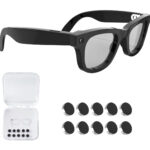


Smart Glasses for Rideshare Drivers: The Dashcam You Actually Wear

Every rideshare driver has at least one story. A passenger who leaves your car trashed. A rating that drops after a ride you could have sworn went fine. A situation that got tense and you had nothing to show for it afterward. A dashcam on your windshield captures the road ahead — but it misses the passenger, your side of the conversation, and most of what actually matters when something goes wrong.
Why Rideshare Drivers Have a Camera Problem
Most dashcams are built for collision documentation. They point forward, sometimes backward, and they do that job well. But for a rideshare driver, the incidents that affect your livelihood rarely happen on the road. They happen in the car.
A false complaint. A passenger who claims you said something you didn’t. A dispute about the drop-off location. A situation that escalated and you needed proof of what actually occurred. A forward-facing dashcam doesn’t capture any of that — and a visible in-cabin camera can make some passengers hostile before the ride even starts.
What Smart Glasses Actually Capture
Camera glasses like the Aventa record from your actual line of sight. You see something — you capture it. That’s a fundamentally different perspective than any mounted camera can offer.
With 1080p video and 12MP photos, the footage is clear enough to hold up when it matters. The built-in microphone records audio alongside video, so you have context, not just visuals. And because the Aventa has open-ear speakers, you can hear navigation or take calls without ever picking up your phone — which is also a legal requirement in most states while driving.
For a rideshare driver, that plays out as:
- Incident documentation from your perspective — not just what a windshield sees, but what you actually saw
- Audio on when you need it — conversations, tone, context all captured
- Hands-free navigation and calls — no fumbling with a phone mount mid-trip
- Prescription lens compatible — if you normally wear glasses, you don’t have to choose
The Discretion Factor
A mounted camera announces itself. Some passengers are fine with it. Others get immediately uncomfortable, and a few get outright hostile. Smart glasses look like glasses. Nobody’s calculating whether you’re recording.
This matters for two reasons. First, you avoid the confrontation that a visible camera can sometimes trigger. Second, you capture natural behavior instead of performance-for-the-camera behavior.
A note on legality: Recording laws vary by state and country. In most US states, one-party consent applies inside a vehicle, meaning you can record conversations you’re part of. That said, laws differ — check your local regulations before using any recording device for this purpose. This article is not legal advice.
Aventa vs. Ray-Ban Meta vs. a Dedicated Dashcam
| Feature | Aventa Smart Glasses | Ray-Ban Meta | Dashcam (windshield) |
|---|---|---|---|
| Price | $109 | $299 | $109–$200+ |
| Camera perspective | Your eye level — inside and outside | Your eye level — inside and outside | Fixed windshield angle, road only |
| Audio recording | Yes | Yes | Varies (most don’t) |
| Hands-free calls and nav | Yes — open-ear speakers | Yes | No |
| Subscription required | No | Meta+ for some features | Often yes, for cloud backup |
| Prescription lens option | Yes | Limited frames | Not applicable |
| Battery | 3 hrs + charging case for full day | ~4 hrs + case | Continuous (hardwired) |
| Weight | 48g | 49g | Not applicable |
Ray-Ban Meta is the better-known product and gets slightly longer battery life on a single charge. But at $299 — and heading toward $300+ — that’s a real number for someone driving rideshare part-time or full-time. The Aventa comes in at $109 and covers the same core use case: POV video, audio, and hands-free operation.
Battery Reality for a Real Shift
Three hours of active use on a single charge. That’s the honest number — it’s not a full 8-hour shift. But the charging case extends your total to a full day of real-world use, factoring in time between rides, wait time, and the fact that you’re not recording every single minute.
In practice: charge the case overnight, keep it in your cupholder. When the glasses need power, drop them in for a few minutes while you wait for your next ping. It’s a workflow adjustment, not a dealbreaker.
Who Should Actually Buy These
- Drivers who’ve had a disputed complaint and wanted proof — and didn’t have it
- Late-night drivers where ride dynamics are less predictable and documentation matters more
- Drivers who already wear prescription glasses and want a single device that handles recording, audio, and vision correction
- Anyone tired of managing a phone mount, a Bluetooth speaker, and a dashcam separately — this consolidates all three
- Drivers who want to try smart glasses without committing $299 to the Ray-Ban Meta first
The Honest Verdict
If your main goal is the best possible road footage — wide angle, strong night vision, continuous loop recording — a dedicated windshield dashcam does that better. That’s worth saying plainly.
But if you want something that captures your perspective — what you saw, what was said, who was in the car — that also handles hands-free audio for navigation and calls, works with your prescription, and costs $109 instead of nearly three times that, smart glasses fill a different need. One that most dashcams miss entirely.
For rideshare drivers who’ve been stuck in a he-said-she-said situation with no proof, that perspective is worth a lot.
The Aventa ships from a US warehouse with 2–5 business day delivery, comes with a 30-day money-back guarantee, and doesn’t require a subscription to use any of its core features. Prescription lenses are available as a custom order — budget an extra 7 business days on the timeline.
Full specs and ordering at aventaglasses.com/products/aventa.
Last updated: April 2026