

Smart Glasses for Nurses: Hands-Free Documentation at Work

If you’re a nurse, you already know the number. Studies consistently put it at two to three hours per shift spent on documentation — charting observations, updating care plans, logging vitals. That’s not time you chose to spend staring at a screen. Smart glasses for healthcare have been discussed in research circles for years, but the hardware was always too expensive, too clunky, or both. That’s starting to change.
The Documentation Burden Is Real
Research published in nursing administration journals puts administrative tasks — most of it documentation — at up to 35% of a nurse’s shift. That’s not a personal failing. It’s a workflow design problem. But the right tools can chip away at it.
The core idea is simple: if you’re already walking the floor, checking rooms, assessing patients, why not capture observations as you go? Voice notes, hands-free wound photos, quick protocol lookups — without hunting for a charting terminal or fishing your phone out of a pocket mid-assessment.
Smart glasses don’t solve the documentation problem entirely. But for specific tasks, they can shave real time off your load and put you back at the bedside faster.
What Smart Glasses Could Actually Do for Healthcare Workers
Here’s where the realistic value sits for nurses and clinical staff:
- Voice-captured observation notes: Speak your assessment while your hands are on the patient. Review the audio later and chart from it, rather than reconstructing from memory at shift end.
- Hands-free wound documentation: A 1080p camera at eye level captures wound progression photos at a consistent angle, every time — without fumbling a tablet while gloved.
- Protocol lookups on the move: Ask the built-in AI assistant about drug interactions, dosing guidelines, or procedure steps without stopping to pull out your phone.
- Remote consults and telehealth: Show a specialist exactly what you’re seeing, in real time, while keeping both hands free for the patient.
- Clinical education and simulation: Nursing educators can capture real-world clinical scenarios — with consent — for training libraries without a dedicated camera operator.
These aren’t hypotheticals. They’re workflow gaps nurses report every shift. The question is whether the hardware is practical enough to actually use on the floor.
The HIPAA Question — Being Honest About This
Any healthcare worker reading this is already thinking about it, so let’s address it directly rather than burying it at the end.
Smart glasses with cameras in clinical settings require thoughtful use. HIPAA doesn’t prohibit wearable cameras — it governs how protected health information is collected, stored, and shared. The same rules that apply when a nurse uses a smartphone to photograph a wound site apply here.
Practical guidelines for clinical use:
- Explicit patient consent before capturing any video or photos for documentation purposes — same as any other recording device.
- Facility policy review first: Check with your compliance team before bringing any wearable camera into clinical spaces. Most hospitals already have smartphone and wearable policies that extend to smart glasses.
- Secure handling of recordings: Don’t leave clinical audio or images on an unencrypted personal device. Treat voice notes the same way you’d treat written notes.
- Intentional recording: You don’t need the camera running all shift. The highest-value use cases are targeted — turn recording on for a specific task, then off. The glasses work as AI audio assistants even when the camera is idle.
None of this is unique to smart glasses. Your smartphone has the same camera and the same AI assistant. The difference is form factor and convenience — which is exactly why it’s worth thinking through your facility’s policies before day one.
For home health nurses and visiting staff, the compliance picture is often simpler. Patients’ homes offer more flexibility, and the documentation workflow is less standardized to begin with.
Aventa Smart Glasses: The Specs That Matter for Clinical Use
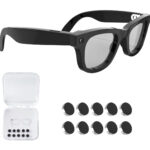
The Aventa Smart Glasses are priced at $109 — low enough to evaluate without a budget committee, high enough that the hardware is real.
What matters for healthcare use:
- 1080p video, 12MP photos: Clear enough for wound documentation and clinical observation capture.
- Built-in AI voice assistant (ChatGPT-compatible): Protocol lookups, voice notes, and hands-free queries without touching your phone.
- Open-ear speakers: You keep full situational awareness — critical in any clinical environment where you need to hear alarms, patients, and colleagues.
- 48g weight: Lighter than Ray-Ban Meta (49g). That matters when you’re wearing something for an eight-hour shift.
- ~3-hour active battery, full-day with charging case: With on-demand use between patient rooms rather than continuous recording, most users get well past three hours before reaching for the case.
- Prescription lens compatible: Custom Rx lenses available and shipped within seven business days — you’re not layering smart glasses over your correctives.
- Bluetooth 5.0: Connects to your phone for extended AI features and call handling.
One honest note on battery: the three-hour figure is for continuous active use — camera and audio running the whole time. In practice, with intentional on/off use between tasks, you’ll get significantly more from a charge.
Aventa vs. Ray-Ban Meta: A Healthcare Perspective
| Feature | Aventa Smart Glasses | Ray-Ban Meta |
|---|---|---|
| Price | $109 | $299 (soon $300+) |
| Camera | 1080p / 12MP | 1080p / 12MP |
| AI assistant | ChatGPT-compatible | Meta AI |
| Weight | 48g | 49g |
| Open-ear audio | Yes | Yes |
| Prescription lenses | Yes (+7 business days) | Yes (via LensCrafters) |
| Subscription required | No | Meta+ for some features |
| US shipping | 2–5 business days from US warehouse | Standard retail |
| Return policy | 30-day money back | Standard retail return |
Ray-Ban Meta is a genuinely good product. The AI features are polished, the ecosystem is mature, and the design is strong. At $299, it’s also a harder sell as a clinical experiment — especially if your facility’s device policy is still evolving.
For hands-free documentation in healthcare, the core requirements are camera quality, voice AI, and comfortable all-day wear. Both glasses deliver on those. Aventa costs $190 less.
Who Should Actually Consider This
Smart glasses for healthcare aren’t right for every role. Here’s where the fit is strongest:
- Home health and visiting nurses: Fewer compliance barriers, natural fit for hands-free documentation during patient visits in non-institutional settings.
- Wound care specialists: Consistent, hands-free photo documentation with both hands on the patient — same angle, every visit.
- Nursing educators and clinical instructors: Capture teaching moments, build simulation libraries, document student performance during clinical rotations.
- ICU and critical care nurses: Voice note capture during complex multi-system assessments when both hands are occupied and a charting terminal is steps away.
- Telehealth and remote triage staff: Real-time visual sharing with remote physicians without a separate camera setup or asking a colleague to hold a phone.
- Nurses who wear prescription glasses: Aventa’s Rx lens option means you’re not wearing two pairs of glasses or sacrificing vision correction for the tech.
If you work in a unit with strict device policies or high-security access areas, check with compliance before buying anything. The glasses aren’t the blocker — organizational policy is, and that varies widely by facility.
The Honest Verdict
Smart glasses for nurses are a real idea, not a gimmick. The workflow gap they address — documentation pulling time away from patient care — is documented, measurable, and something nurses bring up constantly when asked what would actually help.
Whether smart glasses fit your specific role depends on your facility’s policies and how your documentation workflow is structured. But at $109 with a 30-day return window, the cost of finding out is low.
Ray-Ban Meta is the more established product with a deeper AI ecosystem. If you want the most refined experience available and $299 is a straightforward decision, that’s a fair call.
If you want to test whether smart glasses genuinely improve your documentation workflow before spending $300, Aventa at $109 is a practical starting point. It ships from a US warehouse in 2–5 business days, and the 30-day guarantee means you’re not committed if it doesn’t fit how you actually work.
The documentation problem isn’t going away. Tools that help are worth testing.
Last updated: May 2026