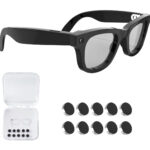


Smart Glasses With No Account Required: What Aventa Keeps Private

Every morning you put on your glasses without thinking about what they might be collecting. But when those glasses have a camera, a microphone, and a voice assistant built in, the question of where your data goes is worth asking before you buy — not after.
If you’ve been comparing smart glasses that require no account against options like Ray-Ban Meta, this guide covers what the difference actually means — not as a talking point, but in real, day-to-day terms.
What “Requires an Account” Actually Means
Ray-Ban Meta requires a Meta account to use the glasses. That’s not optional — without one, the glasses won’t pair or activate.
When you log in, you’re agreeing to Meta’s data policy. The same one that governs Instagram and Facebook now covers your smart glasses too — including the photos you take, the voice queries you make, and how you interact with the device.
Meta processes certain voice commands on their servers to power Meta AI features. Photos can sync to Meta’s cloud. Usage data gets tied to your profile. None of this is hidden — it’s in the terms — but most people don’t read the terms before unboxing.
Do Smart Glasses Spy on You? An Honest Answer
“Spy” implies intent, which isn’t quite fair. But the underlying concern — that your glasses collect more than you realize — is worth taking seriously.
Here’s what different smart glasses actually do with your data:
- Wake word processing: Most always-on voice assistants capture a few seconds of audio before and after the trigger phrase to verify activation. That clip may be uploaded to a server.
- Photo and video sync: Some glasses automatically back up captured media to a cloud service tied to your account.
- Voice assistant queries: Every question you ask is processed on a remote server. That conversation log can be stored and associated with your profile.
- Usage telemetry: App interactions, camera activations, and feature usage are often logged and sent back to the manufacturer.
Not every pair of smart glasses does all of these. But products that require an account almost always do some version — because the account is what ties the data to you.
How Aventa Handles Your Data
Aventa requires no account. You take it out of the box, pair it via Bluetooth, and it works. No registration screen, no terms to accept, no cloud setup.
Photos and videos you capture stay on the glasses until you actively move them to your phone. Nothing uploads automatically. There’s no Aventa cloud service, no media backup running in the background, and no usage profile being built around your habits.
The voice assistant runs through your phone — so if you’re using ChatGPT integration, that data flows through your own OpenAI account, not Aventa’s servers. You control that relationship directly.
The trade-off is worth being honest about: you don’t get deep integration with a large AI ecosystem the way Ray-Ban Meta offers with Meta AI. If that seamless Meta AI experience matters to you, it’s a real point in Ray-Ban’s favor. But if smart glasses with no data sharing is what you’re after, Aventa fits that cleanly.
Side-by-Side Privacy Comparison
| Feature | Aventa ($109) | Ray-Ban Meta ($299) |
|---|---|---|
| Account required | No | Yes — Meta account mandatory |
| Cloud photo sync | No — stays on device | Available, tied to Meta |
| Voice data processing | Via your own accounts (e.g. ChatGPT) | Meta AI servers |
| Usage data collected | No | Yes — per Meta’s privacy policy |
| Works offline (core features) | Yes | Limited |
| Data tied to ad platform | No | Yes — Meta advertising ecosystem |
| Subscription required | No | Meta+ required for some features |
What This Means in Practice
“No account required” isn’t just a privacy slogan — it changes the experience from day one:
- No setup wall: You don’t get stuck on an account creation or verification screen before you can use the glasses.
- No terms that expand over time: When a company updates its privacy policy, every user is affected. With no account, there’s nothing to update you into.
- No exposure if the company gets breached: There’s no Aventa account database that could be compromised — because one doesn’t exist.
- Works without internet for core features: Camera, audio playback, and Bluetooth function without a live connection.
- Simpler relationship: You paid for a product. You use the product. That’s the whole transaction.
If you’d share the glasses with a partner, a teenager, or a family member, the no-account approach means there’s no profile being built around their interactions either.
Who Should Buy Aventa Based on Privacy
- You’ve already left Facebook or Instagram and don’t want Meta back in your life through hardware.
- You use smart glasses for work — in meetings, on-site, or with clients — and don’t want captured audio or images flowing through a third-party cloud.
- You’re buying for a family member who shouldn’t have their data tied to a social media platform.
- You want a device you can just use without an ecosystem to manage, privacy policies to track, or subscriptions to watch for.
- You already have a preferred AI assistant — ChatGPT, for example — and want your voice queries routed there, not to a platform you didn’t choose.
The Honest Verdict
Ray-Ban Meta is a well-made product. At $299, you get deep Meta AI integration, a polished companion app, and a brand that’s been in eyewear for decades. If you’re already inside the Meta ecosystem and those AI features are useful to you, that’s a real argument for paying the premium.
But if your question is “do these smart glasses require me to hand data to an ad platform?” — the answer for Ray-Ban Meta is yes. For Aventa, it’s no.
At $109, Aventa includes 1080p video, 12MP photos, open-ear speakers and microphone, a ChatGPT-compatible voice assistant, Bluetooth 5.0, and prescription lens compatibility. No account. No subscription. No data sharing. It ships from a US warehouse in 2–5 business days and comes with a 30-day money-back guarantee.
If that trade-off works for you, you can pick up the Aventa smart glasses directly at aventaglasses.com.
Last updated: June 2026