

Smart Glasses for Hiking: The Lightweight Trail POV Camera

You’re four miles in when a hawk lands on a branch ten feet away. You freeze. Your phone is in your pack’s hip belt pocket — close enough, but not close enough. By the time you dig it out, unlock it, and open the camera, the hawk is gone. Just another moment that lived in your memory instead of your camera roll.
That’s the quiet frustration of hiking with a phone. And it’s why more hikers are looking at smart glasses as a trail tool — not because they’re tech enthusiasts, but because they’re tired of stopping to film.
Why Hikers Already Hate Extra Gear
Every ounce counts when you’re moving over uneven ground for hours. A GoPro Hero with a chest mount adds around 200g of kit. A phone gimbal is worse. Even clipping your phone to a shoulder strap means you’re grabbing, aiming, and stabilizing before you capture anything worth watching.
The appeal of smart glasses for hiking isn’t really about the glasses. It’s about removing the decision: do I stop and film this, or just keep moving? With a camera on your face, that question disappears.
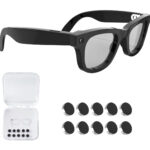
The Aventa G100 weighs 48g. That’s lighter than a Ray-Ban Meta at 49g, lighter than most prescription frames, and roughly the same as a single energy bar. It adds essentially nothing to what you’re already carrying.
What You Actually Get on the Trail
The Aventa shoots 1080p video and 12MP photos — hands-free, triggered by a tap on the frame or a voice command. The built-in open-ear speakers let you take calls, follow navigation audio, or play a podcast without blocking out the sounds around you. That matters more than you might expect when you’re alone on a remote path and need to hear what’s moving in the trees.
Bluetooth 5.0 keeps the connection to your phone stable. Battery life runs about 3 hours of active use, and the charging case extends that to a full day — enough for most day hikes without overthinking your power situation.
There’s a built-in voice assistant that’s ChatGPT-compatible, which is more useful off-trail than on it, but handy for quick queries when you want to ID a plant or check conditions without pulling your phone out.
One honest note: these aren’t rated for submersion. Light rain and sweat are fine. Don’t wear them under a waterfall.
Heat, Sweat, and the Sunlight Problem
Outdoor gear has to perform in outdoor conditions. Here’s what matters for trail running and hiking specifically:
- Heat: There’s no large battery mass baking under glass. Standard summer day-hike temperatures are not an issue.
- Sweat: The frame contacts your nose and ears — same as any other glasses. The materials handle sweat the same way your regular sunglasses do.
- Glare and sunlight: The Aventa is compatible with polarized lenses, which makes a real difference on exposed ridgelines or near water. If you already hike in prescription eyewear, you can order custom prescription lenses — they ship in about 7 business days.
- Camera in bright light: 1080p footage in full sun looks solid. Like any small-sensor camera, heavily backlit shots — shooting toward the sun on an open ridge — will flatten out. Shoot with the sun behind you when you can.
The fit holds up on the trail too. The temples grip the same way sport glasses do. They won’t bounce off your face mid-scramble.
Smart Glasses vs. a Chest-Mounted Action Camera
If you’ve tried a GoPro chest mount for hands-free hiking camera footage, here’s the honest comparison:
| Aventa G100 | GoPro Hero + Chest Mount | |
|---|---|---|
| Weight | 48g | ~200g+ with mount and housing |
| Video resolution | 1080p | Up to 5.3K |
| POV angle | True eye-level | Chest-level (lower, wobblier) |
| Audio | Speakers and mic built in | Mic only |
| Hands-free trigger | Yes — voice and tap | Requires button press or app |
| Wearable off-trail | Yes — looks like glasses | No |
| Price | $109 | $400+ (camera plus mount) |
| Subscription | Not required | GoPro Plus optional |
The GoPro wins on video quality — no argument at 5.3K versus 1080p if you’re editing trail films for a big screen. But for most hikers who want real memories from real hikes, the Aventa is the more practical choice. You’ll actually wear it. The chest rig tends to stay in the car after the second or third trip.
Who Should Buy Aventa for Hiking
- Trail runners who want to capture the experience without holding a phone or buckling on a chest rig mid-run
- Day hikers who keep missing shots because their phone is buried in their pack
- Prescription wearers tired of choosing between seeing clearly and wearing sunglasses on the trail
- Solo hikers who want to take calls or check navigation audio without stopping
- Anyone who’s bought a GoPro chest mount, worn it once, and left it home every trip since
It’s probably not the right fit if you’re producing professional trail films, hiking in sustained heavy rain, or doing multi-day expeditions far from charging options.
The Honest Verdict
The Ray-Ban Meta is the most recognized smart glasses on the market right now, and it earns that reputation. But it costs $299 — heading higher — and locks some features behind a Meta+ subscription. It also means signing into Meta’s ecosystem, which isn’t for everyone.
The Aventa G100 is $109. It ships from a US warehouse in 2-5 business days, and it comes with a 30-day money-back guarantee. For smart glasses hiking use specifically — where you want light, capable, and frictionless — the value math is straightforward.
You’re not getting GoPro-level video quality. You’re getting something you’ll actually take on every hike without a second thought. For most hikers, that trade-off is the whole point.
If that sounds like what you’ve been looking for, the Aventa G100 is available here — prescription options included at checkout for $109.
Last updated: June 2026