

Smart Glasses for Kayaking and Water Sports: What to Know

You’re mid-stroke on the water, the light hits perfectly, and your action camera is strapped to your helmet pointing at the sky. Smart glasses would’ve had that shot. But before you paddle out wearing a pair, you need to understand exactly what “water resistant” means — because there’s a real difference between a splash and a dunking.
Water Resistance Ratings: What IPX4 Actually Means
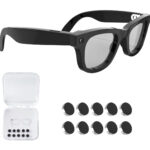
Most smart glasses on the market today — including Aventa and Ray-Ban Meta — carry an IPX4 rating. That means they’re splash-resistant: protected against water spray from any direction.
What IPX4 does not mean: waterproof, submersible, or safe for full water immersion. If you drop them overboard, they’re not coming back working.
Here’s a quick look at the IP scale to put it in context:
| Rating | Protection Level | Water Sports Use |
|---|---|---|
| IPX2 | Dripping water | Indoor use only |
| IPX4 | Splash from any direction | Flatwater, light spray |
| IPX6 | Powerful water jets | Kayaking, whitewater |
| IPX7 | Submersion up to 1m / 30 min | Snorkeling, surfing |
| IPX8 | Deep submersion | Diving |
The honest summary: smart glasses at IPX4 are built for everyday life — rain, sweat, splashing water. They’re not dive computers.
How IPX4 Holds Up Across Different Water Sports
Not all water sports carry the same exposure risk. Here’s how to think through your activity:
- Flatwater kayaking: Paddle drip and the occasional wave splash — IPX4 handles this without issue.
- Stand-up paddleboarding: Similar exposure to flatwater kayaking. Low risk if you stay upright.
- Recreational canoeing: Minimal splash in calm conditions. Generally fine.
- Whitewater kayaking: Heavy spray, hydraulics, and a real possibility of a roll — this pushes past what IPX4 was designed for. Use extreme caution.
- Surfing: IPX4 smart glasses and surfing aren’t a good match. Waves, wipeouts, and full submersion will damage them.
- Swimming or snorkeling: Not recommended for any current smart glasses on the market.
The practical rule: if you might end up fully submerged, leave the smart glasses on shore.
How to Protect Your Smart Glasses on the Water
IPX4 gives you a reasonable safety margin for most paddle sports, but a few habits will go a long way toward protecting your investment.
- Use a retainer strap: A glasses cord ($5–15) keeps them on your face if you lean too far or take a spill. Non-negotiable for kayaking.
- Rinse with fresh water after saltwater exposure: Salt accelerates corrosion on any electronics. A quick rinse after ocean use adds years of life.
- Dry thoroughly before charging: Let them air out before putting them in the charging case, especially around the charging contacts.
- Avoid direct water jets: IPX4 doesn’t mean you can rinse them under a running tap. Use a damp cloth for cleaning.
- Store in the case between sessions: The charging case protects from incidental moisture and impact when you’re not wearing them.
None of this is complicated. Skipping the saltwater rinse is the most common way smart glasses fail early.
The POV Content Opportunity on the Water
Kayaking and paddleboarding content performs consistently well on YouTube. Scenic routes, dawn paddles, whitewater runs — the audience is real, and demand for natural POV footage is high.
The problem with traditional action cameras is the setup. Chest mounts look awkward. Helmet mounts shift. A GoPro strapped to your bow gives you a wide angle, but not your perspective.
Smart glasses film from eye level, in the direction you’re actually looking. That’s the view no mount can fully replicate. Aventa records 1080p video and 12MP photos — solid quality for YouTube, Instagram Reels, and TikTok without dragging along a separate rig.
One honest caveat: Aventa doesn’t have optical image stabilization. On flatwater, footage is smooth. In choppier conditions, expect natural movement. For a lot of paddling content, that’s part of the aesthetic — but worth knowing before you commit.
Aventa vs. Ray-Ban Meta for Water Sports
Ray-Ban Meta is the most common comparison when shopping for smart glasses. Here’s how they stack up specifically for water use:
| Feature | Aventa Smart Glasses | Ray-Ban Meta |
|---|---|---|
| Price | $109 | $299 (and rising) |
| Water Resistance | IPX4 | IPX4 |
| Camera | 1080p / 12MP | 1080p / 12MP |
| Weight | 48g | 49g |
| AI Assistant | Built-in, ChatGPT-compatible | Meta AI |
| Subscription required | No | Meta+ for some features |
| Prescription compatible | Yes (+7 business days) | Yes |
| Charging case | Yes, extends to full day | Yes |
| Ships from US | Yes, 2–5 business days | Varies by retailer |
The water resistance is identical. Both carry IPX4, both carry the same risk profile on the water. The difference is $190 in price — which matters when you’re using electronics somewhere that damage is genuinely possible.
Who Should Buy Aventa Smart Glasses for Water Sports
- Flatwater kayakers and paddleboarders who want hands-free POV footage without a complicated rig
- Outdoor content creators who film on and off the water and want one pair of glasses for both
- Buyers comparing Ray-Ban Meta who want the same IPX4 rating at $190 less
- Prescription wearers who need custom lenses — Aventa supports this with a +7 business day turnaround
- Anyone who wants no ongoing fees — Aventa has no subscription, period
The Honest Verdict
If you’re looking for fully waterproof smart glasses built for surfing or whitewater, they don’t exist yet. IPX4 is the current industry ceiling — and that’s the same rating you get on Ray-Ban Meta at $299.
For flatwater kayaking, paddleboarding, and recreational water sports, Aventa is a sensible choice. The splash resistance handles real-world conditions, the 1080p camera captures solid POV content, and at $109 you’re not risking $300 on a pair that might end up in the lake.
Use a retainer strap. Rinse after saltwater. Keep them out of full submersion. Do those three things and they’ll hold up on the water.
Take a look at the Aventa Smart Glasses — US warehouse shipping, 2–5 business day delivery, and a 30-day money-back guarantee if they’re not for you.
Last updated: May 2026