

Smart Glasses vs Body Cameras for Personal Safety

You’ve seen body cameras clipped to police uniforms — big, boxy, unmistakable. That design makes sense for law enforcement where visibility is part of the point. But if you’re a delivery driver, rideshare worker, security guard, or journalist operating outside an official department, you’re buying retail. And most retail body cams broadcast exactly what they are the moment someone looks at you.
That’s not always what you want.
Smart glasses have entered this conversation quietly. They record 1080p video, look like ordinary eyewear, and go everywhere you go. Whether they’re actually a better tool for personal safety recording than a dedicated body cam depends on your situation — so here’s an honest comparison.
What Body Cameras Actually Do Well
Before writing off body cams, it’s worth being fair. Purpose-built personal recording devices have real strengths.
- Long battery life: Many body cams run 8–12 hours on a single charge. If you’re working a 10-hour shift, that matters.
- Wide-angle coverage: Chest-mounted cams often use 130–170 degree lenses that capture more of the scene than a forward-facing glasses camera.
- Tamper-evident design: For legal evidence purposes, dedicated devices with locked storage are harder to challenge in court.
- Night vision: Higher-end models include IR night vision for low-light recording.
If you’re in a profession where evidence integrity and shift-long battery are the top priorities, a dedicated body cam is still a legitimate choice. That’s the honest baseline.
Where Body Cameras Fall Short
Here’s where the tradeoffs start showing up for everyday users.
- They’re obvious: The visibility that helps uniformed officers works against you in civilian contexts. A chest-mounted cam changes how people interact with you — sometimes for better, often for worse.
- Single purpose: A body cam does one thing. No calls, no audio playback, no smart features — just recording.
- Mounting required: Most need a clip, chest strap, or adhesive mount. Extra hardware every single day.
- Price-to-function ratio: A solid body cam — reliable 1080p, loop recording, decent build — runs $80–$200+. That’s comparable to smart glasses, but with a fraction of the usefulness.
- Social friction: In situations like documenting a property dispute or dealing with an aggressive customer, a visible body cam can escalate tension rather than defuse it.
What Smart Glasses Bring to the Table
Smart glasses don’t replace body cameras in every scenario. But for a large group of people who want passive, discreet recording as part of daily life, they make more practical sense.
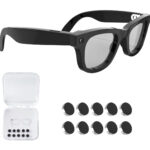
The Aventa Smart Glasses record 1080p video and 12MP photos from a small camera at the temple. You’re wearing glasses — that’s it. No clip, no mount, nothing to explain.
- Your gaze is the camera angle: Hands-free and always positioned wherever you’re looking. No aiming required.
- Open-ear audio: Built-in speakers and a microphone handle calls, voice commands, and audio playback. These are doing multiple jobs at once.
- Voice assistant included: ChatGPT-compatible voice assistant, no subscription required. Ray-Ban Meta locks some features behind Meta+. Aventa doesn’t.
- Bluetooth 5.0: Reliable phone pairing for syncing recordings, music, and calls.
- Prescription-compatible: If you actually need corrective lenses, you can order custom Rx. Those ship in about 7 additional business days.
- Weight: 48g — slightly lighter than Ray-Ban Meta at 49g, and far lighter than any body cam you’d strap to your chest.
Battery runs about 3 hours of active use. The included charging case extends this to a full day of on-and-off use — the same model as wireless earbuds. Not 10-hour body cam territory, but workable for most real-world situations.
Side-by-Side: Smart Glasses vs Body Camera
| Feature | Aventa Smart Glasses ($109) | Typical Body Cam ($80–$200) |
|---|---|---|
| Video quality | 1080p | 1080p (varies by model) |
| Photo capability | 12MP | Limited or none |
| Visual discretion | Looks like regular glasses | Visibly a recording device |
| Battery life | ~3 hrs active + charging case (all-day) | 8–12 hours continuous |
| Calls and audio | Yes — open-ear speakers + mic | No |
| Voice assistant | Yes, ChatGPT-compatible | No |
| Mounting hardware | None — worn as glasses | Clip or strap required |
| Prescription lens option | Yes (+7 business days) | No |
| Night vision | No | Some models, yes |
| Subscription required | No | No |
Who Should Consider Smart Glasses for Personal Safety
This isn’t a tool for everyone. Here’s who it actually makes sense for:
- Delivery and rideshare drivers: Documenting passenger behavior or property condition at drop-off. Glasses don’t feel confrontational the way a visible chest cam does.
- Security guards without issued equipment: If your employer doesn’t provide body cams and you want your own protection, glasses are less policy-ambiguous than a chest mount.
- Journalists and field reporters: Street interviews and candid observation without the camera-out dynamic that changes how people talk to you.
- Property managers and landlords: Documenting walkthroughs and tenant interactions without staging a visible recording setup.
- Anyone navigating difficult personal situations: Custody exchanges, landlord disputes, workplace conflicts — circumstances where you want documentation without escalation.
- Everyday carry: If you want a personal safety camera glasses option that also handles calls and voice assistant tasks throughout the day.
Smart glasses are not the right call if you need 10+ hours of uninterrupted recording, reliable night vision, or legally tamper-evident chain-of-custody storage. For those use cases, a dedicated body cam wins on specs — and you should buy one.
The Honest Verdict
Body cameras and smart glasses solve overlapping problems from different angles. Body cams are built for one thing and do it well for long shifts. Smart glasses are built for all-day usefulness and happen to record everything you see.
Ray-Ban Meta is the obvious smart glasses competitor, at $299. It’s a well-built product. But at nearly three times the price — and with some features gated behind a Meta+ subscription — it’s a harder sell as a practical safety tool for someone who just wants reliable documentation and daily wearability.
At $109, Aventa lands in a different category: close to a decent body cam in price, but with a much broader use case. If you’re comparing a personal recording device that clips to your shirt against one that you’d actually wear every day regardless, that’s the real question — not specs on paper.
For most people reading this, the answer is the second one. The Aventa Smart Glasses ship from a US warehouse in 2–5 business days. There’s a 30-day money back guarantee if they don’t fit what you need.
Last updated: May 2026