

Smart Glasses for Skiing: POV Video Without a Helmet Cam

Your helmet mount adhesive failed at -10°C. Again. The clip you wanted is gone, and you’ve got two minutes of footage that’s 80% sky and 20% your friend’s jacket. If you’ve spent more than one season on the mountain trying to capture good POV footage, you know the routine.
Smart glasses aren’t a replacement for a GoPro strapped to your chest. But for chairlift footage, resort vlogs, and off-slope capture, they’re genuinely worth looking at — and the tradeoffs are more manageable than you’d think.
What Helmet Cams Actually Get Wrong
Action cameras are built for extreme footage. But most ski days aren’t extreme — they’re a mix of cruising, waiting in lift lines, chatting with friends, and getting maybe six good runs in before your legs give out.
For that kind of day, a helmet cam is overkill, and the friction adds up:
- Mounting issues in cold weather: Adhesives and clips fail when temperatures drop. A warm helmet straight from the car plus a cold first run is a recipe for a loose mount.
- Fixed angle: Great for speed shots. Awkward when you want to talk to camera, show the resort view, or capture anything happening at face level.
- Battery drain: Cold kills lithium cells faster. Most action cams lose 30–40% of rated battery in sub-zero temps.
- Separate device to manage: You have your phone, your lift pass, your goggles — and now a second thing to charge, format, and transfer files from.
- Wind noise: At speed, the mic on a helmet-mounted camera picks up almost nothing useful without a foam windscreen.
Smart glasses don’t solve all of these. But they collapse “one more device” into something you’re already wearing.
Can You Actually Wear Smart Glasses Skiing?
This is the question that stops most people. The honest answer: it depends on your setup.
Standard ski goggles won’t fit over most glasses frames without breaking the seal — which means fog, which means you can’t see, which means you’re not skiing. That’s a real constraint.
But there are three scenarios where smart glasses work on the mountain:
- OTG (Over-The-Glasses) goggles: These have a wider frame cutout and deeper foam gasket, designed specifically for glasses wearers. Brands like Smith, Oakley, and OutdoorMaster make OTG options in the $40–150 range. With OTG goggles, layering smart glasses underneath is straightforward.
- Bluebird days, no goggles: If it’s sunny and calm, polarized smart glasses on their own work perfectly. No fog risk, and the camera angle is completely natural.
- Chairlift and off-slope use: This is where smart glasses for snowboarding and skiing genuinely shine. Goggles pushed up, glasses on — capture the view, the conversation, the moment without fumbling for your phone.
The under-goggle scenario is the tricky one. OTG goggles solve it cleanly, but they’re not free and they’re not universal. If you don’t have a pair, that’s a real factor to weigh before buying.
Where the Camera Actually Helps on the Mountain
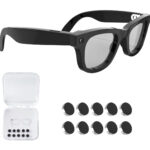
Aventa’s 1080p camera sits at natural eye level, which produces a different kind of footage than a helmet cam. It’s more first-person vlog than action clip — and that’s a feature, not a limitation, depending on what you’re making.
What that’s genuinely good for:
- Chairlift vlogs: Talk to camera, show the mountain, capture the atmosphere. This is genuinely hard to do well with a helmet-mounted action cam pointing at the back of someone’s head.
- Lodge and après content: The whole day isn’t on-slope. A device you wear off the mountain too is more useful than one you peel off in the parking lot.
- Voice commands through gloves: You can trigger video and photos without touching the frames — which matters when your hands are buried in gloves and you’re on a moving lift.
- Mellow-pace slope footage: At cruising speed, a voice-triggered clip captures your line without stopping to press anything. At high speed, image stabilization limits mean a dedicated action cam wins.
For POV ski video glasses, the best footage comes from controlled situations, not race-pace descents. Think scenic slow days, tree runs at mellow speed, and everything that happens between the runs.
Aventa vs. Ray-Ban Meta: Which Makes More Sense for the Mountain?
Ray-Ban Meta is the market leader right now, and it’s a good product. Here’s an honest side-by-side for snow sports use:
| Feature | Aventa Smart Glasses | Ray-Ban Meta |
|---|---|---|
| Price | $109 | $299 |
| Camera | 1080p video, 12MP photos | 1080p video, 12MP photos |
| Weight | 48g | 49g |
| Audio | Open-ear speakers + mic | Open-ear speakers + mic |
| Active battery | ~3 hours + charging case | ~4 hours |
| Subscription required | None | Meta+ for some AI features |
| Prescription lenses | Yes (custom order, +7 business days) | Yes (via Ray-Ban opticians) |
| AI voice assistant | Yes, ChatGPT-compatible | Meta AI |
| US shipping | 2–5 business days from US warehouse | Retail or online |
| Return policy | 30-day money-back guarantee | 30-day return window |
Ray-Ban Meta has the brand recognition and a slightly better rated battery. If you’re deep in the Meta ecosystem, that integration has real value. But if you’re using smart glasses primarily for slope and travel footage — not as a daily Meta platform device — you’re looking at nearly identical camera and audio hardware for $190 less.
Who Should Actually Buy Smart Glasses for the Slopes
These aren’t for every skier or rider. Here’s who gets real value from them:
- Casual to intermediate riders who want chairlift footage and resort vlogs, not race-pace highlight reels.
- Prescription glasses wearers — Aventa offers custom Rx lenses, and the OTG goggle setup is already part of your routine.
- Ski trip travelers who want one device that works at the mountain, the airport, and the city — not a separate action camera to manage.
- Lifestyle content creators making vlog-style snow content. The natural eye-level angle suits that format better than a GoPro-style wide shot from above your forehead.
- Anyone who’s already lost a helmet cam to cold-weather mounting failures and doesn’t want to replace it with the same problem.
Honest Verdict
Smart glasses aren’t going to replace a GoPro Max or Insta360 for serious action footage. If you want stabilized ultra-wide shots of your black-diamond lines at speed, get a dedicated action cam — that’s still the right tool for that job.
But if you want a device that captures the whole ski day — not just the runs — and keeps working when you’re off the mountain, smart glasses make genuine sense. The main constraint is goggles compatibility: OTG goggles are necessary for on-slope use, and that’s worth sorting out before you buy.
At $109, the Aventa smart glasses are priced so that even if you only use them for chairlift footage and resort vlogs, the math works. You’re not betting $300 on a use case you haven’t tested yet. Both come with a 30-day money-back guarantee, so you can take them on a trip and return if the fit doesn’t work for your skiing style.
Last updated: June 2026