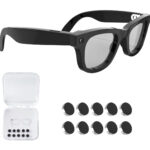


Can Smart Glasses Replace Your Phone for a Day? We Tried It.

You reach for your phone around 96 times a day. Most of those reaches aren’t urgent — they’re habit. A bored hand, a half-formed question, a moment you want to capture. What if a pair of glasses could handle half of them?
That’s the question we set out to answer. One full day. Aventa Smart Glasses on, phone in the bag as much as possible. Calls, AI queries, photos, navigation — all of it through the frames. Here’s what actually happened.
The Setup
The rules were simple: glasses on, phone in the bag. Reach for the phone only when the glasses genuinely couldn’t do the job. No cheating, no cherry-picking the easy tasks.
One thing worth noting before the day even started — the Aventa glasses weigh 48g. That’s actually lighter than Ray-Ban Meta at 49g. It sounds trivial until you’ve worn heavy frames for six hours and your ears are done. These stayed comfortable all day. That matters more than any spec sheet will tell you.
Morning: Calls, Music, and the Commute
First real test: a phone call at 7am, walking to the coffee shop. Both sides heard each other clearly. The open-ear speakers let you stay in the world — you can hear traffic, people, your surroundings — without the isolation of earbuds. For a morning commute call, that’s actually the right trade-off.
Music worked well enough for walking. Open-ear audio won’t satisfy an audiophile in a quiet room, but out in the world, where you want ambient awareness, it fits. Nobody’s going to cancel their AirPods over this. But you might leave the AirPods home more often than you expect.
The voice assistant handled three quick queries before 9am: weather check, a reminder set, a business’s opening hours. All hands-free, all accurate. The ChatGPT-compatible assistant isn’t gimmicky — it responds the way you’d expect a capable voice assistant to respond.
Midday: Photos and AI Queries
Lunch with a decent view. Instead of pulling out the phone to photograph it, one voice command and the 12MP camera captured it. The photos hold up — sharp in good light, nothing that’ll embarrass you. The 1080p video is the same story: solid, not cinematic.
The more interesting thing is what you’re not doing. You’re not staring at a screen trying to frame the shot. You’re present. The moment gets recorded without the moment getting interrupted.
We threw a variety of AI queries at the glasses throughout the day: draft a short reply to this message, what’s the conversion rate on this, summarize this concept. It handled all of them. You have to speak clearly, especially in noisier spaces — the microphone is good, not magic. But for practical, on-the-go queries, it works reliably.
Navigation: Better Than Expected, With One Caveat
Navigation is where most smart glasses experiments fall apart. There’s no heads-up display here — no arrows projected into your field of view. You get audio turn-by-turn directions. That’s a genuine limitation, and it’s worth being straight about.
For walking, though? It worked fine. Audio directions while your hands are free and your phone is in your pocket is a legitimate upgrade over holding the phone out in front of you like a compass. Three separate errands, no wrong turns.
For driving, you still want a screen. No argument there. But for anyone who walks or takes transit, this is more useful than it sounds in theory.
Where the Phone Still Won
No experiment is honest without this part.
- Reading anything: Texts, email threads, articles, menus — if you need to read it, you need the phone. The glasses are audio-first by design.
- Battery limits: Active battery life is around 3 hours. The charging case extends you through a full day, but you’re swapping glasses in and out rather than wearing them continuously.
- Noisy environments: Loud bars, busy streets, crowded spaces — the voice assistant misses words. So does every voice assistant in the same conditions.
- Complex tasks: Booking anything, filling out a form, reviewing a document — phone territory, full stop.
None of this is a knock on the product. It’s just the category being honest with itself. Smart glasses in 2025 are an extension of your phone, not a replacement. The experiment proved that — but also showed the extension is more useful than most people assume.
Aventa vs. Ray-Ban Meta: What the $190 Difference Buys You
| Feature | Aventa Smart Glasses | Ray-Ban Meta |
|---|---|---|
| Price | $109 | $299 (increasing) |
| Camera | 12MP / 1080p video | 12MP / 1080p video |
| AI assistant | ChatGPT-compatible | Meta AI |
| Weight | 48g | 49g |
| Audio | Open-ear speakers | Open-ear speakers |
| Bluetooth | 5.0 | 5.3 |
| Subscription required | No | Meta+ for some features |
| Prescription compatible | Yes (custom, +7 business days) | Yes (via third party) |
| Shipping | US warehouse, 2–5 business days | Varies |
| Return window | 30-day money back | 30-day |
Ray-Ban Meta is a good product. The frame options, the brand name, the Meta AI ecosystem — if that’s what you want, it delivers. There’s a reason it’s the market benchmark.
But the gap between ChatGPT-compatible AI and Meta AI is narrower than most people realize in daily use. The gap between $109 and $299 is not. You’re mostly paying for the logo and Bluetooth 5.3 — which you will never actually notice.
Who Should Buy Smart Glasses Right Now
- Daily commuters who want hands-free calls and audio without earbuds every morning
- Walkers and cyclists who want audio navigation and ambient awareness at the same time
- Content creators who want first-person footage without holding a phone up constantly
- Prescription wearers who’ve been locked out of the category — Aventa does custom Rx lenses
- Curious early adopters who want to actually live with smart glasses before the category matures, without a $300 bet
If most of your phone use involves reading, complex tasks, or you commute primarily by car, be honest with yourself. The glasses will help less, and that’s okay — that’s not what they’re built for yet.
Verdict
Can smart glasses replace your phone for a day? No — but that’s the wrong question. The right question is how many of your mindless phone reaches they can absorb, and whether offloading those is worth something to you.
After a full day, the answer was: more than we expected. Long stretches where the phone never came out. Calls taken, questions answered, moments captured, all without looking down.
At $109, with free shipping from a US warehouse, 30-day returns, and no subscription fees attached, the Aventa Smart Glasses are a low-cost way to find out which side of that answer you land on. If they don’t fit your life, you return them. If they do, you’ll wonder why you waited until a $300 version to try.
Last updated: June 2026